FireBeetle ESP32-E IoT Development Board(N16R8)

SKU: DFR1139

The FireBeetle ESP32-E IoT Development Board (N16R8) comes with 16M Flash and 2M PSRAM, enhancing memory capacity and operating space. It offers an impressive performance for applications like the LVGL graphics library, based on the ESP32-WROOM-32E-N16R2 module featuring a 32-bit dual-core processor with up to 240MHz clock frequency. It supports WiFi and Bluetooth communication, making it ideal for IoT scenarios. The board includes rich peripheral interfaces such as digital and analog pins, multiple UART, SPI, I2C, I2S, and DAC interfaces, meeting various hardware connection needs. It supports dual power supply modes with USB and external 3.7V lithium battery, and offers multiple programming methods including Arduino IDE, ESP-IDF, and MicroPython. With compact dimensions of 25.4mm × 60mm, it is easy to embed into PCB prototypes. Suitable for home automation, IoT prototyping, remote control, and LVGL projects, it is a low-power IoT development board in the FireBeetle series.

Board Overview of FireBeetle 2 ESP32-E (N16R2) IoT Microcontroller
  • Docs
  • Tech Specs
  • Projects
  • Specification

    Power Parameters

    Parameter Details
    Input Voltage USB-C interface: 5V DC
    PH2.0 interface: 3.7V Li-ion
    VCC pin: 5V DC

    MCU Parameters

    Parameter Details
    Processor Tensilica LX6 dual-core processor (one core for high-speed connectivity, one core for independent application development)
    Clock Frequency 240MHz
    SRAM 520KB
    ROM 448KB
    Flash 16MB
    PSRAM 2MB
    On-chip Clock 40MHz crystal oscillator, 32.768KHz crystal oscillator

    Wireless Parameters

    Parameter Details
    Wi-Fi Standard FCC/CE/TELEC/KCC
    Wi-Fi Protocol 802.11 b/g/n/d/e/i/k/r (802.11n, up to 150 Mbps), A-MPDU and A-MSDU aggregation, supports 0.4us protection interval
    Wi-Fi Frequency Range 2.4~2.5 GHz
    Bluetooth Protocol Compliant with Bluetooth V4.2 BR/EDR and BLE standards
    Bluetooth Audio CVSD and SBC audio
    Bluetooth Frequency Range 2.4~2.5GHz

    Peripheral Parameters

    Parameter Details
    Digital Pins × 17: IO0, IO1, IO2, IO3, IO4, IO12, IO13, IO14, IO15, IO17, IO18, IO19, IO21, IO22, IO23, IO25, IO26
    Analog Pins × 11: IO0, IO2, IO4, IO12, IO13, IO14, IO15, IO25, IO26, I34, I35
    UART Interfaces ×3
    SPI Interface ×1
    I2C Interface ×1
    I2S Interface ×1
    DAC Interface ×2
    Touch Interfaces ×7
    LED PWM Channels ×16
    RGB_LED WS2812
    Display Interface GDI

    Other Parameters

    Parameter Details
    Interface Compatibility FireBeetle V2 series compatible
    Module Size 25.4mm × 60mm
    Weight 23.4g

    DFR0997-Function description

    No. Function Description
    USB Interface Program download and power supply, 4.75V-5.5V compatible
    Charging Indicator Red LED for indicating charging status: 1. Off when fully charged or not charged; 2. On when charging; 3. Quick flash when powered by USB, and no battery connected.
    User Button Controlled by pin IO27/D4
    Li-ion Battery Port Support 3.5V-4.2V
    Onboard RGB Light WS2812 RGB LED, controlled by pin IO5/D8
    Onboard LED LED controlled by pin IO2/D9
    Reset Button Press to reset program
    Low-power Solder Jumper Pad Designed for low power mode and default to be connected. Slightly cut off the thin wire with a knife to disconnect it. When disconnected, static power consumption can be reduced by 500 μA. The power consumption can be reduced to 13 μA after controlling the maincontroller to enter the sleep mode through the program.
    Note: when the pad is disconnected, you can only drive RGB LED light via the USB Power supply.
    GDI DFRobot dedicated Display interface. Refer to the GDI part of this page.
    ESP32-E Module ESP32-WROOM-32E-N16R2

    Pinout

    DFR1139-Pinout

    Categroy Description
    Control FireBeetle enable/reset pins
    Touch Pin with capacitive touch function
    Analog Analog pin
    Port PIN Default physical pin number of the chip, which can be used to directly control the corresponding pin
    Arduino IDE In Arduino IDE, the pin numbers have been remapped by FireBeetle, and you can directly use this symbol to control the corresponding pin
    RTC PIN FireBeetle 2 ESP32-E supports low power function, and in Deep-sleep mode, only RTC pin keeps working and can be used as a wave-up source. When RTC pin is used as an output pin, it keeps outputting level value when the chip is in Deep-sleep mode, while as an input pin, it can wake up the chip from Deep-sleep.
    GND Common ground for all power supplies and logics
    Power When powered by 5V-USB, VCC outputs about 4.7V and 3V3 outputs 3.3V; When powered by 4V li-ion battery, VCC outputs about 4V and 3V3 outputs 3.3V(Actual measurement)

    FireBeetle 2 ESP32-E(N16R2) has up to 21 physical GPIOs, which are mainly for connecting peripherals like sensors, actuators, etc. Meanwhile, these IO pins can be multiplexed for other functions such as UART, SPI, I2C and so on. The table below provides users with a detailed description of FireBeetle 2 ESP32-E(N16R2) GPIO.

    Pin Number Name Function ADC Communication Remark
    GPIO 0 0/D5 Used as input or output ADC2_CH1 Occupied when using USB transmission
    GPIO 1 1/TXD Used as input or output UART0_TX Occupied when using USB power supply and serial printing
    GPIO 2 2/D9 Used as input or output ADC2_CH2 For controlling onboard LED by outputting digital signal
    GPIO 3 3/RXD Used as input or output UART0_RX Occupied when using USB power supply and serial printing
    GPIO 4 4/D12 Used as input or output ADC2_CH0
    GPIO 12 12/D13 Used as input or output ADC2_CH5
    GPIO 13 13/D7 Used as input or output ADC2_CH4

    Notice:

    • It is recommended not to multiplex the pin IO0/D5, IO1/TXD and IO3/RX since they will be occupied when using USB-related function. The USB-related circuit design is shown below:

      DFR1139-Pinout 1

    • IO34-39 are for input only.

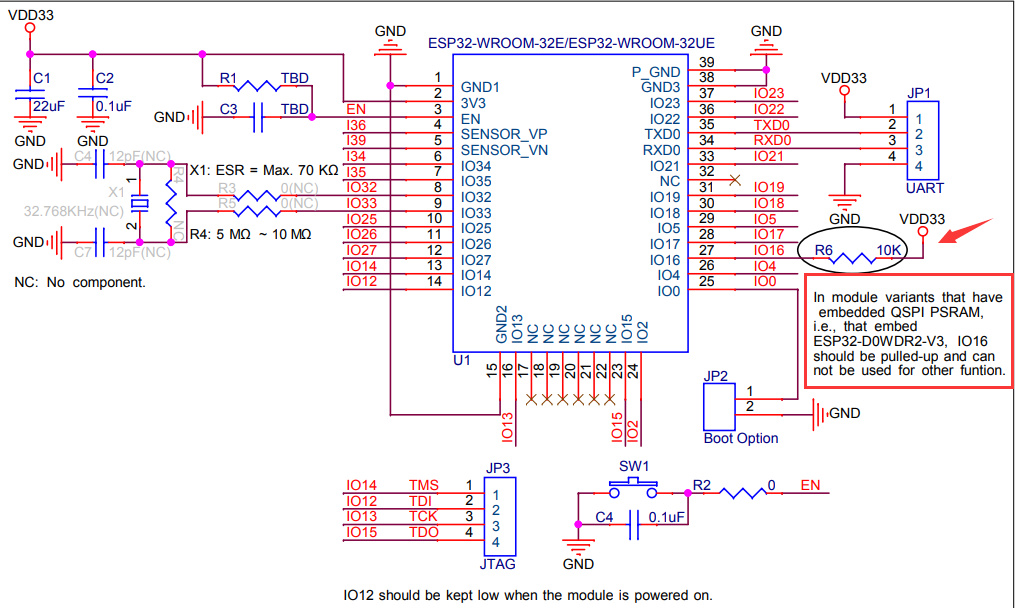
    • NC Pin Explanation: Originally designated as IO16/D11 pin, it is now changed to NC pin, which means it should not be used for any other functions. Please refer to the datasheet for the reasons behind this change.

      DFR1139-Pinout 2

    • FireBeetle 2 ESP32-E(N16R2) has two 8-bit DAC channel that converts 2-way digital signal to 2 analog voltage outputs. Two channels can work independently. DAC circuit is composed of built-in resistors in series and a buffer. The two DACs can be used as reference voltage.

    Was this article helpful?

    TOP