Gravity: Infrared Carbon Dioxide / CO2 Sensor (0-50000 ppm)

SKU: SEN0220

DFRobot released its latest wide range infrared CO2 sensor (0~50000ppm) based on NDIR tech—good selectivity, oxygen-free dependency. It has temperature compensation, UART communication, is easy to use and compatible with Arduino, Raspberry Pi. With 5-year lifespan, it also features high sensitivity, low power, fast response, anti-water vapor, high stability.

Front of NDIR CO2 sensor with cylindrical and rectangular components-DFRobot product sku:SEN0220 image.

Downloadable Resources

  • Docs
  • Tech Specs
  • Specification

    Parameter Value
    Gas Detection Carbon Dioxide (CO₂)
    Operating Voltage 4.5 ~ 5.5V DC
    Average Current <85mA
    Output Signal UART
    Measuring Range 0 ~ 50000ppm
    Accuracy ± (50ppm + 5% reading)
    Preheating Time 3min
    Response Time T90 < 30s
    Operating Temperature 0 ~ 50 ℃
    Operating Humidity 0 ~ 95% RH (no condensation)
    Service Life >5 years
    Board Dimension 21 * 27.11 mm/ 0.83 * 1.06 inches
    Weight 42 g

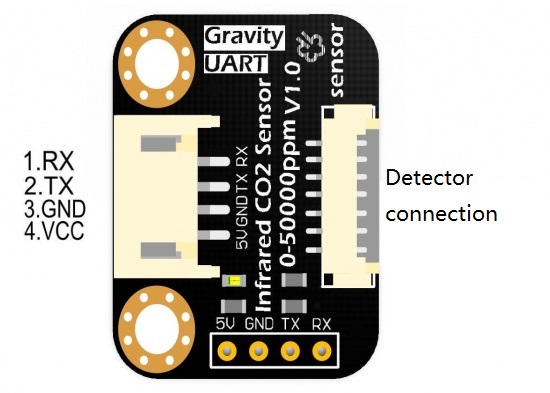
    Pinout

    SEN0220 CO2 Sensor

    Num Label Description
    1 RX RX
    2 TX TX
    3 GND GND
    4 VCC VCC
    5 Detector connection Detector connection

    FAQ

    • How to choose from the many CO2 sensors on the platform?

      Choosing a suitable CO2 sensor requires consideration of multiple factors, including the sensor's accuracy, measurement range, response time, reliability, price, and more. Additionally, it is important to select the appropriate sensor type based on the specific needs of the application, such as wall-mounted, portable, or embedded. You can also refer to this CO2 sensor selection guide for further assistance.

    • Does CO2 sensor need maintenance?

      CO2 sensors require regular calibration to ensure accurate measurement of CO2 concentration. In addition, the sensor should be kept clean, and the sensor filter should be replaced regularly to prevent the accumulation of dust or other particles that may affect measurement accuracy.

    • What should be paid attention to when installing the CO2 sensor?

      Proper installation of CO2 sensors is crucial for accurate monitoring of indoor CO2 levels. Here are a few points to consider when installing the sensors:

      Placement: CO2 sensors should be installed in areas where CO2 levels need to be monitored, such as enclosed rooms with poor air circulation. However, they should be placed away from areas that are easily disturbed or contaminated, such as near doors, windows, and ventilation ducts.

      Avoid direct sunlight: Sensors should not be installed in direct sunlight to avoid temperature changes that may cause errors in measurements.

      Avoid contamination: Sensors should be installed in clean, dust-free, oil-free, and chemical-free areas.

      Avoid heat sources: Sensors should be placed away from heat sources to prevent high temperatures that may affect measurement accuracy.

    • What are the application areas of CO2 sensors?

      CO2 sensors are widely used in various scenarios, including indoor air quality monitoring, intelligent building control, greenhouse gas monitoring, and more. In industrial environments, CO2 sensors can also be used to monitor the concentration of CO2 in chemical reactions.

    • What is a CO2 sensor and what is its purpose?

      A CO2 sensor is a device used to detect the concentration of carbon dioxide (CO2) in the environment. Its primary function is to assist in monitoring indoor air quality, ensuring that those who work or reside indoors are not exposed to harmful concentrations of CO2.

    Explore More Related Questions >

    Was this article helpful?

    TOP