
Example Code for Arduino-Read PAR Value
This project demonstrates how to read the photosynthetically active radiation (PAR) value from the RS485 PAR Sensor (SEN0641) using an Arduino UNO R3. Users will learn to interface the sensor with an Arduino via a Gravity: Active Isolated RS485 to UART Signal Adapter Module (DFR0845) and use the Modbus-RTU protocol to retrieve the PAR value for environmental or agricultural monitoring.
Hardware Preparation
- Name: DFRduino UNO R3 (or similar), Model/SKU: DFR0009, Quantity: 1, Purchase Link: DFRduino UNO R3
- Name: Gravity: Active Isolated RS485 to UART Signal Adapter Module, Model/SKU: DFR0845, Quantity: 1, Purchase Link: Gravity: Active Isolated RS485 to UART Signal Adapter Module
- Name: RS485 Photosynthetically Active Radiation (PAR) Sensor, Model/SKU: SEN0641, Quantity: 1, Purchase Link: RS485 PAR Sensor
Software Preparation
- Development Tool: Arduino IDE, Version: Latest, Download Link: Arduino IDE
Wiring Diagram
If the power of the RS485 device is small and the required current is less than 12V-160mA, the RS485 to UART signal conversion module does not require a 12V external power supply, making wiring more convenient.
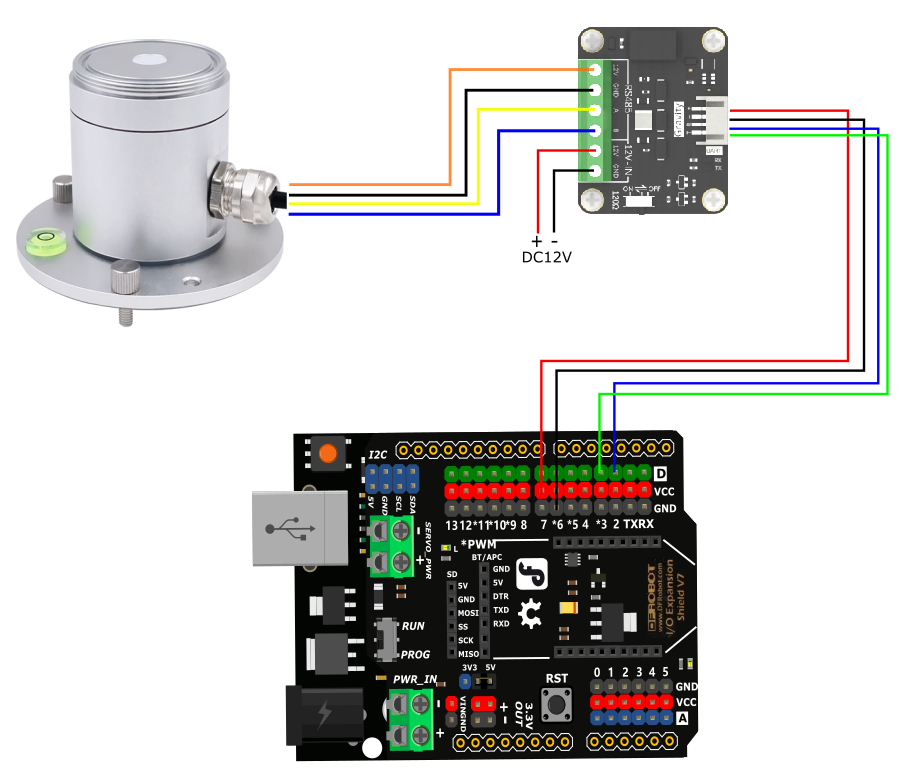
Other Preparation Work
- Ensure the sensor’s protective cover is removed to allow light to reach the sensing element.
- If the RS485 device’s power consumption is less than 12V-160mA, the Gravity: Active Isolated RS485 to UART module does not require an external 12V power supply.
- Verify the 485-A and 485-B lines are connected correctly (no reverse polarity).
Sample Code
#include <SoftwareSerial.h>
SoftwareSerial mySerial(2,3);
uint8_t Com[8] = { 0x01, 0x03, 0x00, 0x00, 0x00, 0x01, 0x84, 0x0A };
int PAR;
void setup() {
  Serial.begin(9600);
  mySerial.begin(4800);
}
void loop() {
  readPAR();
  Serial.print("PAR = ");
  Serial.print(PAR);
  Serial.println(" umol/m²·s ");
  delay(1000);
}

void readPAR(void) {
  uint8_t Data[10] = { 0 };
  uint8_t ch = 0;
  bool flag = 1;
  while (flag) {
    delay(100);
    mySerial.write(Com, 8);
    delay(100);
    if (readN(&ch, 1) == 1) {
      if (ch == 0x01) {
        Data[0] = ch;
        if (readN(&ch, 1) == 1) {
          if (ch == 0x03) {
            Data[1] = ch;
            if (readN(&ch, 1) == 1) {
              if (ch == 0x02) {
                Data[2] = ch;
                if (readN(&Data[3], 4) == 4) {
                  if (CRC16_2(Data, 5) == (Data[5] * 256 + Data[6])) {
                    PAR = Data[3] * 256 + Data[4];
                    flag = 0;
                  }
                }
              }
            }
          }
        }
      }
    }
    mySerial.flush();
  }
}

uint8_t readN(uint8_t *buf, size_t len) {
  size_t offset = 0, left = len;
  int16_t Tineout = 500;
  uint8_t *buffer = buf;
  long curr = millis();
  while (left) {
    if (mySerial.available()) {
      buffer[offset] = mySerial.read();
      offset++;
      left--;
    }
    if (millis() - curr > Tineout) {
      break;
    }
  }
  return offset;
}

unsigned int CRC16_2(unsigned char *buf, int len) {
  unsigned int crc = 0xFFFF;
  for (int pos = 0; pos < len; pos++) {
    crc ^= (unsigned int)buf[pos];
    for (int i = 8; i != 0; i--) {
      if ((crc & 0x0001) != 0) {
        crc >>= 1;
        crc ^= 0xA001;
      } else {
        crc >>= 1;
      }
    }
  }

  crc = ((crc & 0x00ff) << 8) | ((crc & 0xff00) >> 8);
  return crc;
}
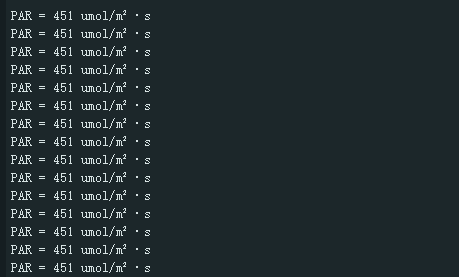
Result
Print the collected photosynthetically active radiation value, which cannot be collected by ordinary indoor light sources.
Was this article helpful?