
Example Code for Arduino-Continuously Recognize Faces, Palm Prints
Arduino example for continuous face and palm vein recognition using DFRduino UNO R3, Gravity IO Expansion Shield and FP01 offline AI vision sensor, ideal for DIY access control and STEM projects
Hardware Preparation
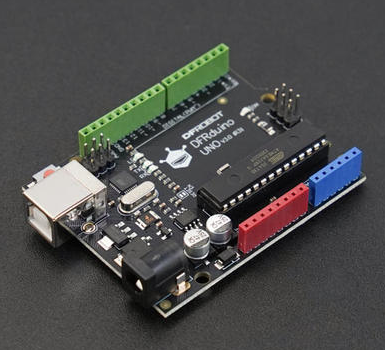
- DFRduino UNO R3 x 1
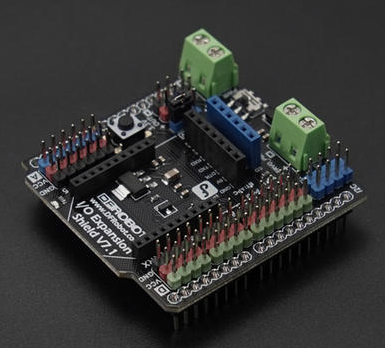
- Gravity: IO Expansion Shield for Arduino V7.1 x 1
- FP01 Offline AI Vision Recognition Sensor (Face & Palm Vein) x 1
- SH1.0-6Pin to 2.54mm DuPont cable x1
Software Preparation
- Arduino IDE
- Download DFRobot_Biometric library
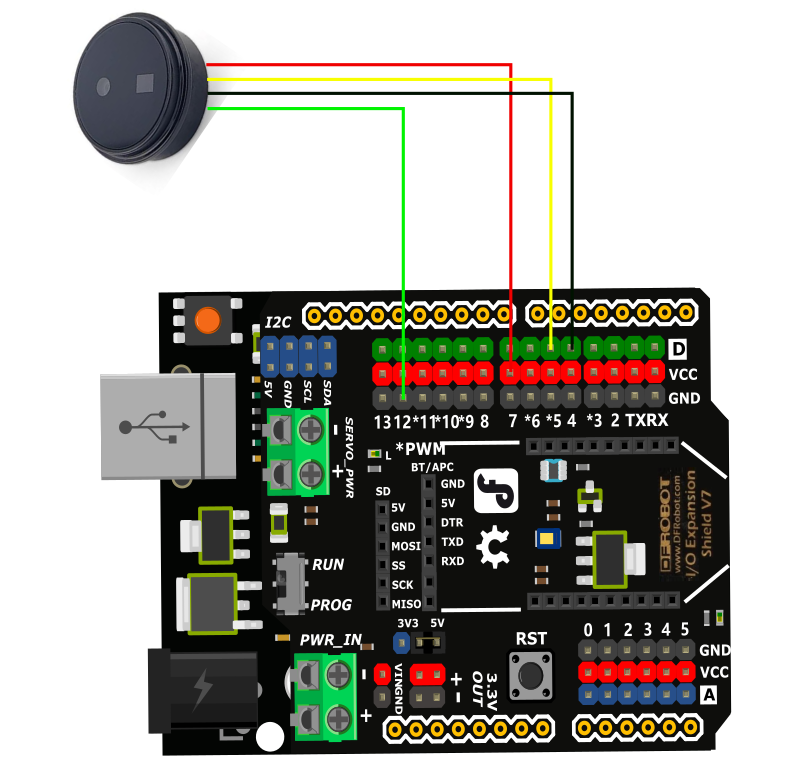
Wiring Diagram
Other Preparation Work
It continuously recognizes faces and palm prints, and prints the corresponding information via a serial port monitor. If it fails to recognize a face, it can slightly adjust its distance or posture and remain stationary. Recognition distance: 20-90cm for faces, 10-20cm for veins and palm prints.
Sample Code
/*!
 * @file recognition.ino
 * @brief Continuous automatic user recognition routine for SEN0736 and SEN0737
 * @details This routine periodically detects faces, automatically recognizes them
 * @n and prints user details via the serial port.
 * @copyright Copyright (c) 2026 DFRobot Co.Ltd (http://www.dfrobot.com)
 * @license The MIT License (MIT)
 * @author [Olive](feng.yang@dfrobot.com)
 * @version V1.0.0
 * @date 2026-06-02
 * @url https://github.com/DFRobot/DFRobot_Biometric
 */

#include "DFRobot_Biometric.h"

/* -----------------------------------------------------------------------------------------------------
  *    board   |             MCU                |   Leonardo/Mega2560/M0  |   ESP8266  |     ESP32     |
  *     VCC    |            3.3V/5V             |          VCC            |    VCC     |      VCC      |
  *     GND    |              GND               |          GND            |    GND     |      GND      |
  *     RX     |              TX                |      Serial1 TX1        |    5/D6    |  Serial2 TX1  |
  *     TX     |              RX                |      Serial1 RX1        |    4/D7    |  Serial2 RX1  |
  * ----------------------------------------------------------------------------------------------------*/
/* Baud rate cannot be changed , it is 115200 */

#if defined(ESP8266) || defined(ARDUINO_AVR_UNO)
#define SOFT_RX_PIN 4
#define SOFT_TX_PIN 5
#include <SoftwareSerial.h>
SoftwareSerial ModuleSerial(SOFT_RX_PIN, SOFT_TX_PIN);
#elif defined(ESP32)
#define RX_PIN       16
#define TX_PIN       17
#define ModuleSerial Serial2
#else
#define ModuleSerial Serial1
#endif

DFRobot_Biometric face(ModuleSerial);

void setup()
{
#if defined(ESP32)
  ModuleSerial.begin(115200, SERIAL_8N1, RX_PIN, TX_PIN);
#else
  ModuleSerial.begin(115200);
#endif

  Serial.begin(115200);    //Start serial 1, for information printing
  delay(2000);             //Wait for module to start
}

void loop()
{
  // put your main code here, to run repeatedly:
  while (face.checkState() == false) {    //Determine whether the module is ready
    Serial.println("Module not ready !");
    delay(200);
  }
  Serial.println("Module ready!");
  Serial.println("-------------------------------------------------------------------------------");
  DFRobot_Biometric::sId_t user   = { 0, DFRobot_Biometric::eFaceUser, DFRobot_Biometric::eRoleNormal, { 0 } };    //Store the recognized user information
  int8_t                   result = 0;
  Serial.println("Start recognition. Face the camera directly. Palm vein: 10-20cm, Face: 20-90cm");
  result = face.getRecognitionResult(&user);
  //Determine the execution result
  if (result == 1) {
    Serial.println("Recognition successful! The information of the user:");
    Serial.print("id:");
    Serial.println(user.id);
    Serial.print("userName:");
    Serial.println(user.userName);
    Serial.print("user kind:");
    if (user.kind == face.eFaceUser) {
      Serial.println("face user");
    } else if (user.kind == face.ePalmUser) {
      Serial.println("palm user");
    }
    Serial.print("userClass:");
    if (user.isAdmin == face.eRoleNormal) {
      Serial.println("Normal user");
    } else if (user.isAdmin == face.eRoleAdmin) {
      Serial.println("Administrator");
    }
  } else if (result == 2) {
    Serial.println("User recognition timeout");
  } else if (result == NO_ACK) {
    Serial.println("No response from module");
  } else if (result == 3) {
    Serial.println("Recognized user not found");
  }
  Serial.println("-------------------------------------------------------------------------------");
  Serial.println("");
  delay(10000);
}
Result
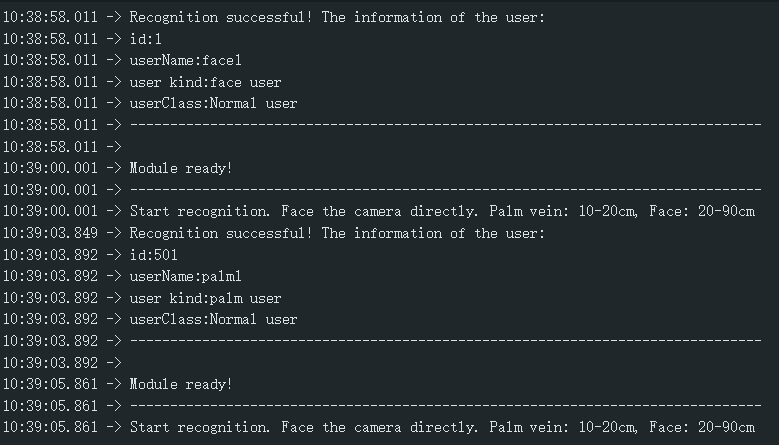
The system continuously identifies detected faces and palm prints, and prints the corresponding information via serial port.
Was this article helpful?