
Reference
Library
- For Arduino: DFRobot_MAX17043 Library. How to install the library?
- For Raspberry Pi: DFRobot_MAX17043 RaspberryPi library
Communication Protocol Description
- Interface: Gravity I2C (logic level: 0-3.3V)
- I2C Address: Fixed to 0x36
Principle
The Gravity 3.7V Lithium Battery Fuel Gauge employs Maxim's patented algorithm to real-time track the relative state of charge (SOC) of the battery. It eliminates the need for full-to-empty relearning and offset accumulation errors. The module features ultra-low operating current and a low battery power alert interrupt function.
Other Supplementary Information
Build a Solar Power Management System
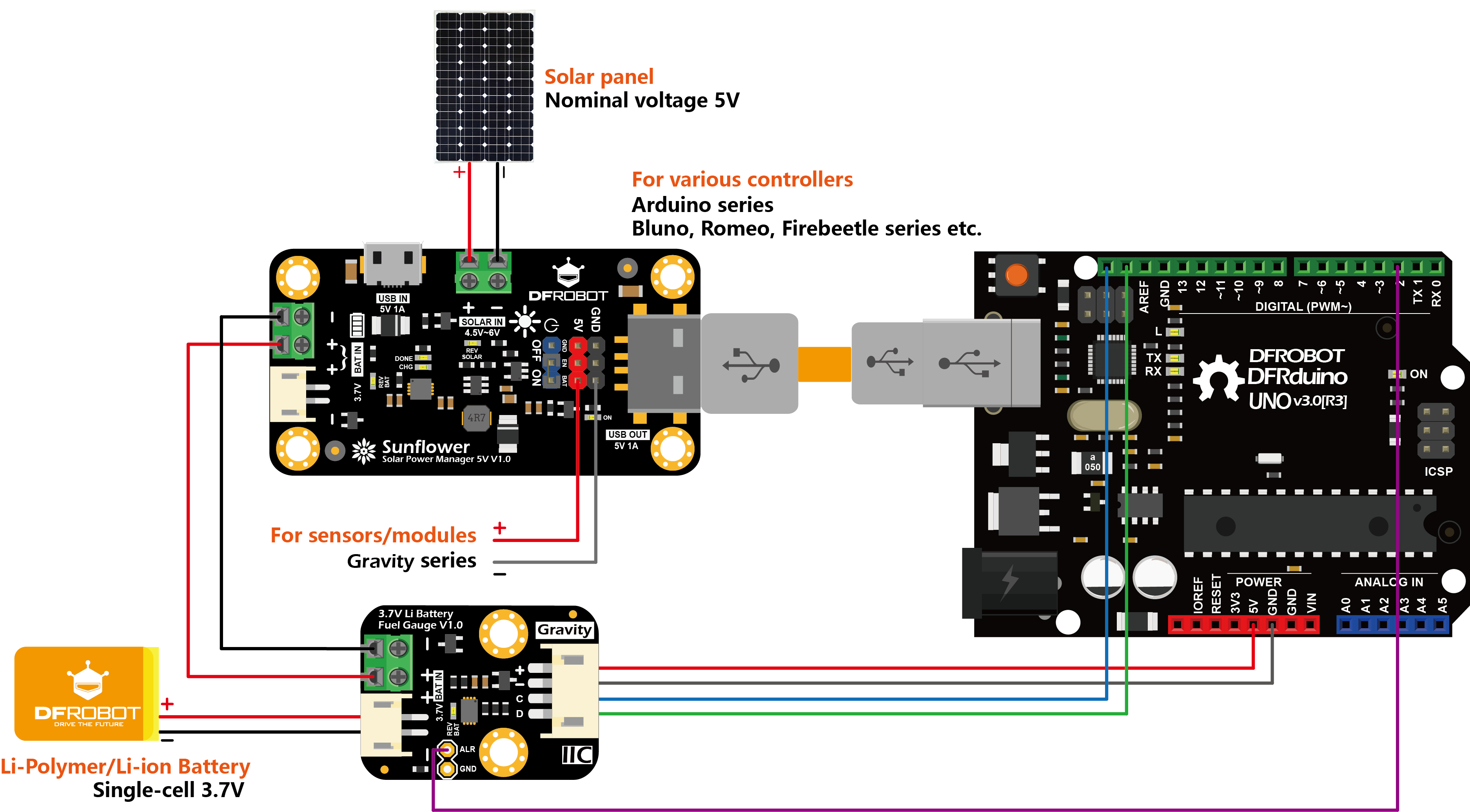
Gravity: 3.7V Li Battery Fuel Gauge can be used with the Solar Power Manager 5V to build a solar power management system. The battery fuel gauge can be used to monitor the charging of the battery with a solar panel in real time during the day, and the power consumption of the system during the night. Users can write their own code to record or print battery voltage and remaining power data, which can be employed to evaluate the "power balance" of the solar system in a day or even several months. These datum helps users to determine whether the nominal power of the panel or lithium battery power is large enough to fully support the entire system during the day and night.
The low power interrupt alert of the fuel gauge and controllable 5V power supply of the solar power management module can be used to save power when the battery power is lower than a specified threshold. The ALR pin will send an interrupt signal to trigger the controller to turn off the 5V power supply. This shuts off the power supply of external modules connected to the solar power module, and thus saves power.
Was this article helpful?