
Example Code for Arduino-DC Current Measurement
Last revision 2025/12/08
This project shows how to get raw datas from the 50A Current Sensor (DC) (SKU:SEN0098) through Arduino and convert the raw datas to the value of the current according to the datasheet. A smoothing algorithm is used to make the outputting current value more reliable.
Wiring Diagram

⚠DANGER: This diagram can also be applied to AC current connection. But notice that the module should be cascaded on one electric wire ( +/- ). If you connect it to two electric wires in parallel, you will short the circuit , which is dangerous.
Sample Code
/*
50A Current Sensor(DC)(SKU:SEN0098) Sample Code
This code shows you how to get raw datas from the sensor through Arduino and
convert the raw datas to the value of the current according to the datasheet;

Smoothing algorithm (http://www.arduino.cc/en/Tutorial/Smoothing) is used to
make the outputting current value more reliable;

Created 27 December 2011 @Barry Machine @www.dfrobot.com
*/

const int numReadings = 30;
float readings[numReadings];      // the readings from the analog input
int index = 0;                  // the index of the current reading
float total = 0;                  // the running total
float average = 0;                // the average

float currentValue = 0;

void setup()
{
  Serial.begin(115200);
  for (int thisReading = 0; thisReading < numReadings; thisReading  )
    readings[thisReading] = 0;
}
void loop()
{
    total= total - readings[index];
    readings[index] = analogRead(0); //Raw data reading
//Data processing:510-raw data from analogRead when the input is 0;
// 5-5v; the first 0.04-0.04V/A(sensitivity); the second 0.04-offset val;
    readings[index] = (readings[index]-512)*5/1024/0.04-0.04;

    total= total   readings[index];
    index = index   1;
    if (index >= numReadings)
      index = 0;
    average = total/numReadings;   //Smoothing algorithm (http://www.arduino.cc/en/Tutorial/Smoothing)
    currentValue= average;
    Serial.println(currentValue);
    delay(10);
}
Result
After uploading the sample sketch, open the serial monitor to monitor your results. You may find that when the current is 0A, the reading is not 0A. In this case, you need to revise the code for some small calibrations as the steps below:
1 Check the initial current value when the input is 0A:
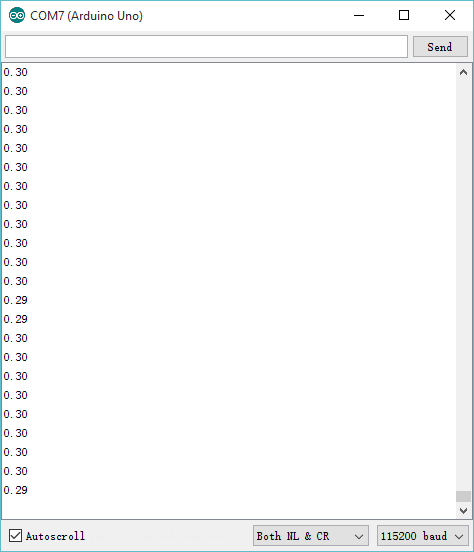
2 Caculate the initial current value:
-0.34 = -0.04 - ( 0.30 );
3 Revise the sample sketch:
readings[index] = (readings[index]-510)*5/1024/0.04-0.34;//
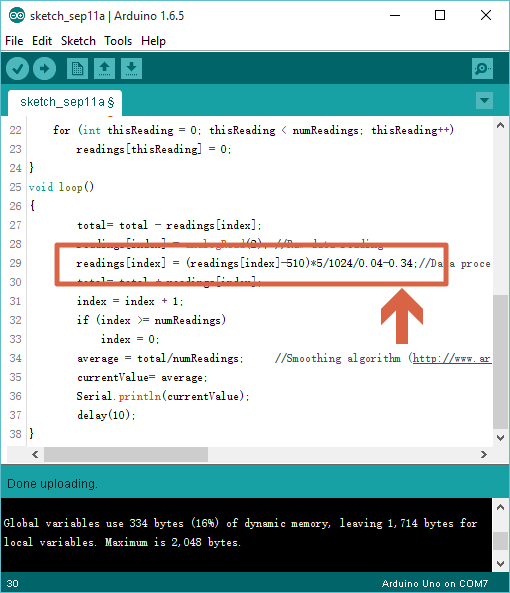
4 Upload your new sketch again, then you will find the readings are around 0A, if not, please do the steps above several times to make it.
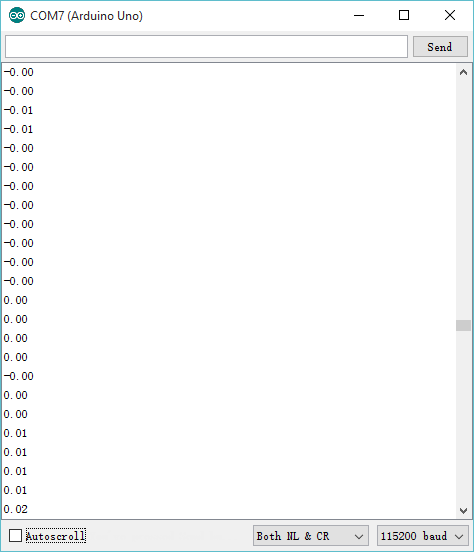
5 As shown above, it can be applied to detect the current value accurately, and output analog voltage signals.
Additional Information
Signal Convert formula:

- I: Current, in A
- Uout: Voltage on the OUT pin, in V
If I is calculated as a negative number, it means that the current flows from OUT to IN of the module.
Was this article helpful?