
Example Code for Arduino-M0-External interrupt function
Last revision 2026/01/19
This example demonstrates interrupt detection. When acceleration on a selected axis exceeds or falls below the set threshold, the interrupt signal can be detected on the INT1/INT2 pin.
Hardware Preparation
- Firebeetle Board-M0 × 1
- LIS331HH Triple Axis Accelerometer × 1
- Some Jumper wires
Software Preparation
- Arduino IDE
- Download and install the LIS Series Library and Sample Code (About how to install the library?)
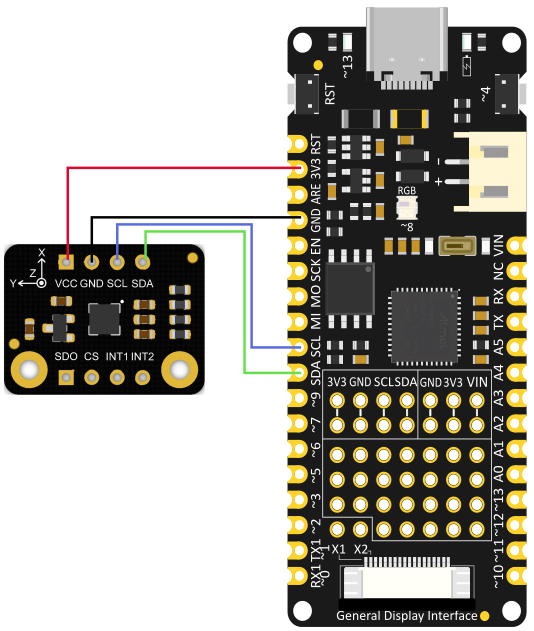
Wiring Diagram
Connect your sensor to an M0 controller (or others) according to the connection diagram below.
Other Preparation Work
- Select interrupt.ino.
- Program Burning.
Sample Code
/**!
 * @file interrupt.ino
 * @brief Interrupt detection
 * @n In this example, the enable eZHigherThanTh interrupt event means when the acceleration in the Z direction exceeds the
 * @n the threshold set by the program, the interrupt level can be detected on the interrupt pin int1/int2 we set, and the level change
 * @n on the interrupt pin can be used to determine whether the interrupt occurs. The following are the 6 settable interrupt events:
 * @n eXHigherThanTh, eXLowerThanTh, eYHigherThanTh, eYLowerThanTh, eZHigherThanTh,eZLowerThanTh.
 * @n For a detailed explanation of each of them, please look up the comments of the enableInterruptEvent() function.
 * @n This example needs to connect the int2/int1 pin of the module to the interrupt pin of the motherboard. Default UNO(2),
 * @n             Mega2560(2), Leonardo(3), microbit(P0),FireBeetle-ESP8266(D6),FireBeetle-ESP32((D6),FireBeetle-M0(6)
 * @copyright  Copyright (c) 2010 DFRobot Co.Ltd (http://www.dfrobot.com)
 * @licence     The MIT License (MIT)
 * @author [fengli](li.feng@dfrobot.com)
 * @version  V1.0
 * @date  2021-01-16
 * @get from https://www.dfrobot.com
 * @https://github.com/DFRobot/DFRobot_LIS
 */

#include <DFRobot_LIS.h>
//When using I2C communication, use the following program to construct an object by DFRobot_LIS331HH_I2C
/*!
 * @brief Constructor
 * @param pWire I2c controller
 * @param addr  I2C address(0x18/0x19)
 */
//DFRobot_LIS331HH_I2C acce(&Wire,0x18);
DFRobot_LIS331HH_I2C acce;

//When using SPI communication, use the following program to construct an object by DFRobot_LIS331HH_SPI
#if defined(ESP32) || defined(ESP8266)
#define LIS331HH_CS  D3
#elif defined(__AVR__) || defined(ARDUINO_SAM_ZERO)
#define LIS331HH_CS 3
#elif (defined NRF5)
#define LIS331HH_CS 2  //The pin on the development board with the corresponding silkscreen printed as P2
#endif
/*!
 * @brief Constructor
 * @param cs Chip selection pinChip selection pin
 * @param spi SPI controller
 */
//DFRobot_LIS331HH_SPI acce(/*cs = */LIS331HH_CS,&SPI);
//DFRobot_LIS331HH_SPI acce(/*cs = */LIS331HH_CS);

volatile uint8_t intFlag = 0;

void interEvent(){
   intFlag = 1;
}

void setup(void){

  Serial.begin(9600);
  //Chip initialization
  while(!acce.begin()){
     delay(1000);
     Serial.println("Initialization failed, please check the connection and I2C address setting");
  }
  Serial.print("chip id : ");
  Serial.println(acce.getID(),HEX);

  /**
    set range:Range(g)
              eLis331hh_6g = 6,/<±6g>/
              eLis331hh_12g = 12,/<±12g>/
              eLis331hh_24g = 24/<±24g>/
  */
  acce.setRange(/*range = */DFRobot_LIS::eLis331hh_6g);

  /**
    Set data measurement rate:
      ePowerDown_0HZ = 0,
      eLowPower_halfHZ,
      eLowPower_1HZ,
      eLowPower_2HZ,
      eLowPower_5HZ,
      eLowPower_10HZ,
      eNormal_50HZ,
      eNormal_100HZ,
      eNormal_400HZ,
      eNormal_1000HZ,
  */
  acce.setAcquireRate(/*rate = */DFRobot_LIS::eLowPower_2HZ);
  #if defined(ESP32) || defined(ESP8266)
  //The D6 pin is used as the interrupt pin by default, and other non-conflicting pins can also be selected as the external interrupt pin.
  attachInterrupt(digitalPinToInterrupt(D6)/*Query the interrupt number of the D6 pin*/,interEvent,CHANGE);
  #elif defined(ARDUINO_SAM_ZERO)
  //The pin 5 is used as the interrupt pin by default, and other non-conflicting pins can also be selected as the external interrupt pin.
  attachInterrupt(digitalPinToInterrupt(5)/*Query the interrupt number of the pin 5*/,interEvent,CHANGE);
  #else
  /*    The Correspondence Table of AVR Series Arduino Interrupt Pins And Terminal Numbers
   * ---------------------------------------------------------------------------------------
   * |                                        |  DigitalPin  | 2  | 3  |                   |
   * |    Uno, Nano, Mini, other 328-based    |--------------------------------------------|
   * |                                        | Interrupt No | 0  | 1  |                   |
   * |-------------------------------------------------------------------------------------|
   * |                                        |    Pin       | 2  | 3  | 21 | 20 | 19 | 18 |
   * |               Mega2560                 |--------------------------------------------|
   * |                                        | Interrupt No | 0  | 1  | 2  | 3  | 4  | 5  |
   * |-------------------------------------------------------------------------------------|
   * |                                        |    Pin       | 3  | 2  | 0  | 1  | 7  |    |
   * |    Leonardo, other 32u4-based          |--------------------------------------------|
   * |                                        | Interrupt No | 0  | 1  | 2  | 3  | 4  |    |
   * |--------------------------------------------------------------------------------------
   */
  /*                      The Correspondence Table of micro:bit Interrupt Pins And Terminal Numbers
   * ---------------------------------------------------------------------------------------------------------------------------------------------
   * |             micro:bit                       | DigitalPin |P0-P20 can be used as an external interrupt                                     |
   * |  (When using as an external interrupt,      |---------------------------------------------------------------------------------------------|
   * |no need to set it to input mode with pinMode)|Interrupt No|Interrupt number is a pin digital value, such as P0 interrupt number 0, P1 is 1 |
   * |-------------------------------------------------------------------------------------------------------------------------------------------|
   */
  attachInterrupt(/*Interrupt No*/0,interEvent,CHANGE);//Open the external interrupt 0, connect INT1/2 to the digital pin of the main control:
     //UNO(2), Mega2560(2), Leonardo(3), microbit(P0).
  #endif
  /**
    Set the threshold of interrupt source 1 interrupt
    threshold:Threshold(g)
   */
  acce.setInt1Th(/*Threshold = */2);

  /*!
    Enable interrupt
    Interrupt pin selection:
      eINT1 = 0,/<int1 >/
      eINT2,/<int2>/
    Interrupt event selection:
      eXLowerThanTh ,/<The acceleration in the x direction is less than the threshold>/
      eXHigherThanTh ,/<The acceleration in the x direction is greater than the threshold>/
      eYLowerThanTh,/<The acceleration in the y direction is less than the threshold>/
      eYHigherThanTh,/<The acceleration in the y direction is greater than the threshold>/
      eZLowerThanTh,/<The acceleration in the z direction is less than the threshold>/
      eZHigherThanTh,/<The acceleration in the z direction is greater than the threshold>/
   */
  acce.enableInterruptEvent(/*int pin*/DFRobot_LIS::eINT1,/*interrupt = */DFRobot_LIS::eZHigherThanTh);

  delay(1000);
}

void loop(void){
   //Get the acceleration in the three directions of xyz
   //The mearsurement range is ±6g, ±12g or ±24g, set by the setRange() function
   Serial.print("Acceleration x: ");
   Serial.print(acce.readAccX());
   Serial.print(" mg \ty: ");
   Serial.print(acce.readAccY());
   Serial.print(" mg \tz: ");
   Serial.print(acce.readAccZ());
   Serial.println(" mg");

   if(intFlag == 1){
      //Check whether the interrupt event is generated in int1
      if(acce.getInt1Event(DFRobot_LIS::eYHigherThanTh)){
        Serial.println("The acceleration in the y direction is greater than the threshold");
      }
     if(acce.getInt1Event(DFRobot_LIS::eZHigherThanTh)){
       Serial.println("The acceleration in the z direction is greater than the threshold");
      }
      if(acce.getInt1Event(DFRobot_LIS::eXHigherThanTh)){
        Serial.println("The acceleration in the x direction is greater than the threshold");
      }
      intFlag = 0;
   }
   delay(300);
}
Result

Additional Information
Select interrupt.ino.

Was this article helpful?