Dear Sir/Madam,
I bought this shield last month. I followed the instructions to set up the kit. However, it does not work. I used an external power supply (AC-DC) with 9V, 2A rating to power up the kit. I connected the power supply to Arduino, the power lid is ON with red colour, the lid state is OFF and the network lid is also in OFF state. In addition, I programmed the Arduino, however, the shield is not working. I don’t know what is the problem exactly. I would be grateful if you can guid me to sort this problem. Thank you in advanced.
Look forward to hearing from you.
Best wishes
MCS Hussain alaa
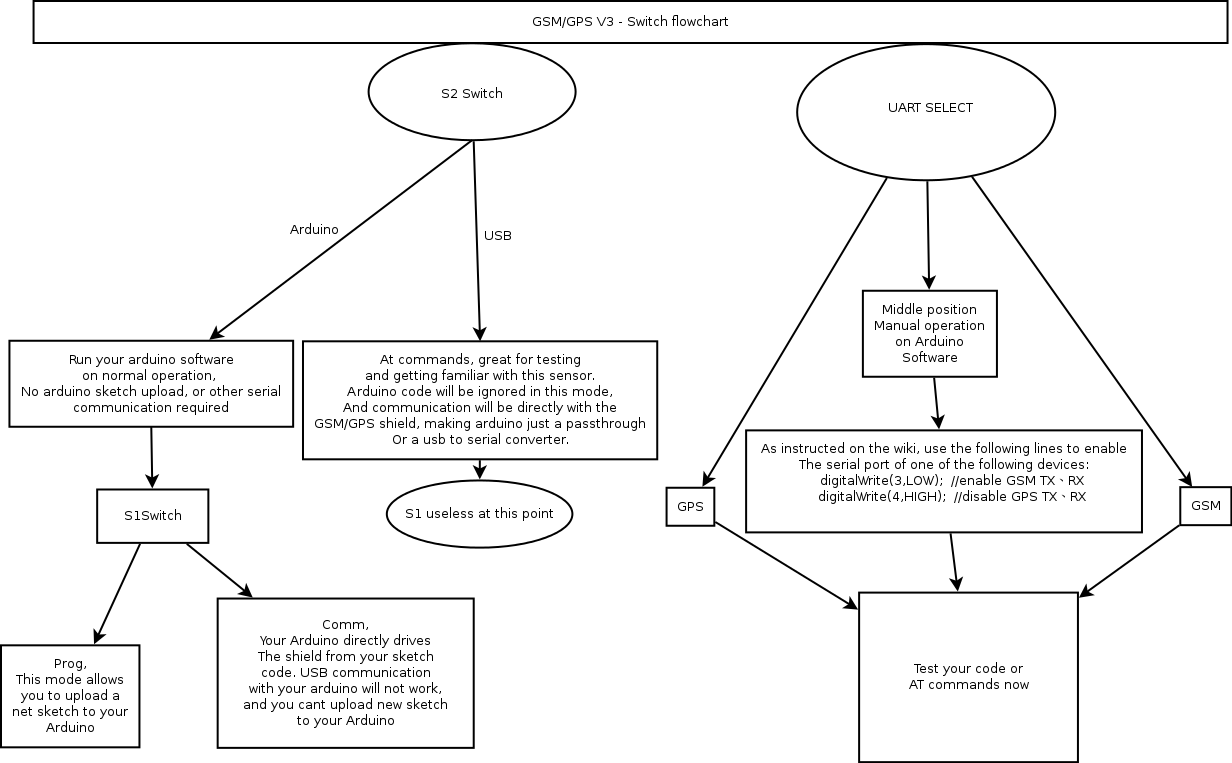
The power supply is given through 7V, 2A battery and the uart switch was positioned in the middle. The shield was even tested outside..
Hi, I buyI bought a shield, but is not working. I put the sample project, but does not work, replace the name of the APN, username and key ... any help?
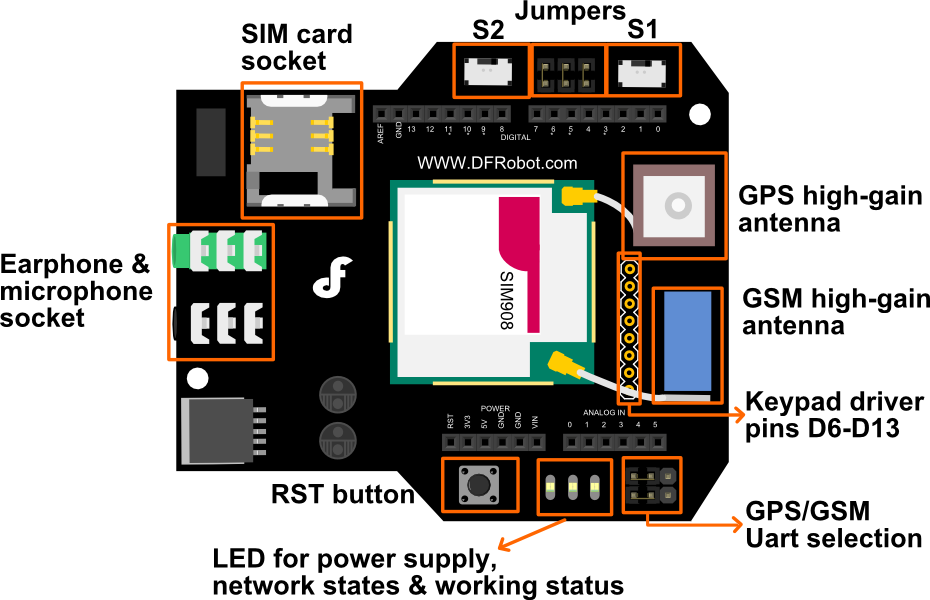
Don't forget 3 driver pins, you could connect them via jumper caps. Anyway, you will require an external power, since GSM shield will requires more current.
How to drive the module via USB port (AT command) using Leonardo after changing Serial to Serial1?
Hi, you are right that to modify the Serial into Serial1 for Leonardo using the sample sketches. But for to AT mode, it is very similar to this board, SIM808 with Leonardo mainboard SKU:DFR0355, i.e. you have to use the code below (For GPS debug) for AT command debugging, also the switches should be set as: S1: Comm; S2: Arduino; S3 should set as the same as above tutorial. One more note is the external power should be added as Leonardo costs more power even in GPS feature test.
void setup() {
Serial.begin(9600); //initialize Serial(i.e. USB port)
Serial1.begin(9600); //initialize Serial1
//Init the driver pins for GSM function
pinMode(3, OUTPUT);
pinMode(4, OUTPUT);
pinMode(5, OUTPUT);
//Output GSM Timing
digitalWrite(5, HIGH);
delay(1500);
digitalWrite(5, LOW);
digitalWrite(3, HIGH); //disable GSM TX、RX
digitalWrite(4, HIGH); //disable GPS TX、RX
while (!Serial) {
; // wait for serial port to connect.
// Needed for native USB port only
}
Serial.println("Input AT please...");
}
void loop() {
while (Serial1.available()) {
Serial.write(Serial1.read());
}
while (Serial.available()) {
Serial1.write(Serial.read());
}
delay(1);
}
}
I have tried restarting the shield multiple times, each time the shield initiate normally with Stat and Net LED turned on. The moment I **connect to the shield via serial**, both green light would **turn off**. I had tried diagnosing the problem with Module Tester(Serial monitor). On the rare occasion a connection was establish, it would display a response like **normal power off**. What's the problem with it?
Once the module detect the serial signal_Reset, it will reset, then the module would power down, namely the State and NET LED would turn off. And the the Reset signal can be triggered by any one of these operation
① hit the botton_RST(reset) on the shield/ Arduino card
② when you pull the switch_S1 from Prog to Comm (or contrary)
③ when you open Arduino Serial Monitor or connect the serial port by other Serial Testers.To reboot the module (light up the State&Net LED), you can hit the button_Reset or you can re-open the Serial Monitor.
Serial port terminal application warns “Normal power down” when reconnect after disconnect, and Network indication LEDs both turn off.
Choose disconnect, and connect again. Arduino board will reset at every connection to PC. During resetting, the Arduino board will emit a low pulse to pin PWRKEY of GPS module. So if GPS module is already on before connection, the low pulse will switch it off, if not, the pulse will switched it on.