AI Binocular Face, Palm Vein & QR Code Recognition Sensor

SKU: SEN0677

The AI Binocular Face, Palm Vein & QR Code Recognition Sensor uses an AI chip with 2MP color/infrared cameras (dark-environment recognition). It has fast startup (Linux OS) and embedded algorithms (3D liveness, neural network, QR code, palm print/vein) for face, QR code, palm vein recognition. Outputs via UART; USB supports UVC video (expandable UAC). Dual power modes (low power/constant) with auto detection. Plug-and-play, easy integration, versatile for smart home, door locks, payment terminals.

Overview of AI Binocular Vision Recognition Sensor (Face / Palm Vein / QR Code)

Downloadable Resources

  • Docs
  • Tech Specs
  • 1. Getting Started

    The article offers a detailed guide on installing AI vision modules, focusing on optimal installation heights, recommended tilt angles, cover plate materials, and proper assembly to prevent imaging issues and enhance performance.

    2. Example Code for Arduino-Registering Face & Palm Print

    When registering face or palm print, you need to fix the AI visual sensor and pay attention to the recognition distance, 30-120cm for face, 15cm for vein palm print, and 15cm for QR code. Only one face or palm print is registered each time. If you need to register multiple, you can press the reset button of the UNO R3 development board to register other faces or palm prints again.

    3. Example Code for Arduino-Continuously Recognize Faces, Palm Prints, and QR Codes

    Continuously identify faces, palm prints, and QR codes, and print the corresponding information through the serial port monitor. If it cannot be recognized, you can adjust the distance or posture slightly and keep it still.

    4. Example Code for Arduino-User Statistics & Deletion

    Input command: AT+GETUSERS, query all user numbers and IDs; AT+DELUSER=1, delete the specified user ID1, 1 can be replaced by other user IDs; AT+DELALLUSERS, delete all registered users.

    Reference

    This article delves into the UART communication protocol and API functions, providing comprehensive instructions for user management, including enrolling and deleting users, as well as enabling recognition through face, palm, and QR code methods. It highlights efficient data management techniques for optimal use.

    Specification

    Hardware Parameters

    Parameter Details
    SoC Arm CPU@900MHz, [email protected], RISC-V@600MHz
    DDR2 64MB
    Flash 32MB
    Cameras Dual 1/5” CMOS, 2MP, dual MIPI interfaces
    Lens FOV: 83° diagonal; optimal focus: 60cm
    LED IR@850nm, RGB@650nm (90° illumination)
    USB UVC video transmission (expandable to UAC); MJPEG output (H.264/YUY2 expandable)
    Communication UART@115200 baud

    Power Parameters

    Parameter Details
    Supply voltage 5-12V
    Operating current 320-330mA@8V
    Standby current 120–130mA (auto-detection mode)
    Shutdown current 0µA (non-auto-detection mode)

    Other Parameters

    Parameter Details
    Operating temperature -20°C to +60°C
    Storage temperature -30°C to +70°C
    Humidity 10–93% RH (non-condensing)
    Audio I/O Expandable (speaker/microphone)
    Boot time 900ms–2.5s (varies with stored user count)
    User capacity 1,000 faces; 1,000 palm veins
    Algorithms Binocular liveness detection, deep learning face recognition, palm vein recognition, QR code recognition
    Liveness metrics FAR (False Acceptance Rate) ≤1%; FRR (False Rejection Rate) ≤1%
    Face recognition Pass rate: 98.85%; FAR: 0.001%; Recognition angle: ±20° pitch/yaw; supports multi-angle enrollment
    Detection range Face: 30–120cm,Palm vein/QR code: 15cm
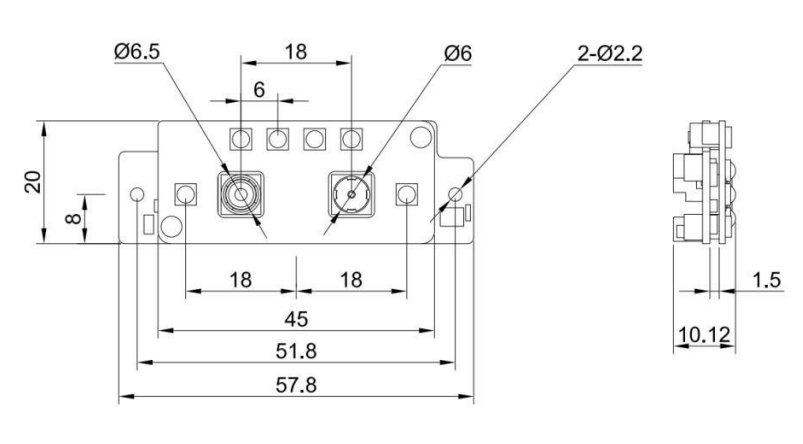
    Dimensions 57.8×20×10.12mm

    Pinout

    UART interface

    Pin Color line sequence Function description
    1 Black line GND
    2 Yellow line UART_RX
    3 Green line UART_TX
    4 Red line VCC 5~12V

    USB interface

    Can output video signals for screen display, support standard UVC video, MJPEG/YUY2/H.264 encoding, and have horizontal and vertical screens with multiple resolutions. Can be expanded to realize UAC audio function, can realize voice intercom function.

    Pin Functional Description
    1 VCC 5V
    2 Floating
    3 DM USB data line D-
    4 DP USB data line D+
    5 GND

    Microphone interface (reserved)

    Mainly used to receive sound signals and realize intercom function

    Pin Name Functional Description
    1 Negative pole MIC-
    2 Positive pole MIC+

    Speaker interface (reserved)

    Mainly used for voice playback

    Pin Name Functional Description
    1 SPK 1W/8Ω
    2 SPK 1W/8Ω

    Dimensional Drawing

    FAQ

    • What must be done when the sensor is in use?
      The sensor USB port must be connected to a 5V USB power supply
    • Is chip heating normal?
      Yes, chip heating is normal
    • Can the foam on both sides of the camera be removed?
      No, the foam on both sides of the camera cannot be removed

    Explore More Related Questions >

    Was this article helpful?

    TOP