
For M0--Sample code 6-Free fall interrupt function(freeFallInterrupt.ino)
Requirements
-
Hardware
- Firebeetle Board-M0 x 1
- LIS2DW12 Triple Axis Accelerometer x1
- Jumper wires x1
-
Software
- Arduino IDE
- Download and install the LIS Series Library and Sample Code. (About how to install the library?)
- About how to use Firebeetle Board-M0?
Connection
Connect your sensor to M0 controller.
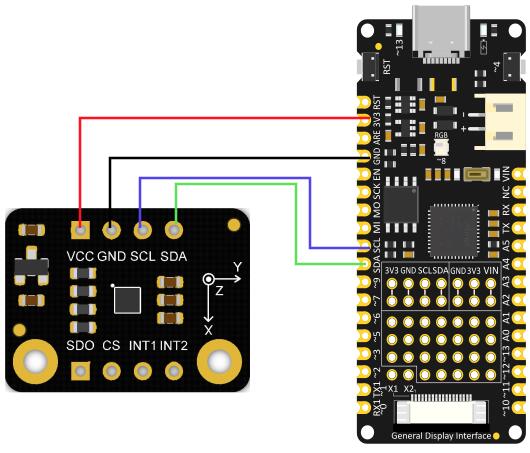
Sample code 6-Free fall interrupt function(freeFallInterrupt.ino)
- Select freeFallInterrupt.ino

- Program Burning
/**!
 * @file freeFallInterrupt.ino
 * @brief Interrupt detection of free fall, an interrupt signal will be generated in int1 once a free fall event occurs.
 * @n When a free-fall motion is detected, it will be printed on the serial port.
 * @n When using SPI, chip select pin can be modified by changing the value of LIS2DW12_CS
 * @n In this example, the int2/int1 pin on the module needs to be connected to the interrupt pin on the motherboard. Default UNO(2),
 * @n                                 Mega2560(2), Leonardo(3), microbit(P0),FireBeetle-ESP8266(D6),FireBeetle-ESP32((D6),FireBeetle-M0(6)
 * @copyright  Copyright (c) 2010 DFRobot Co.Ltd (http://www.dfrobot.com)
 * @licence     The MIT License (MIT)
 * @author [fengli](li.feng@dfrobot.com)
 * @version  V1.0
 * @date  2021-01-16
 * @get from https://www.dfrobot.com
 * @https://github.com/DFRobot/DFRobot_LIS
 */
#include <DFRobot_LIS2DW12.h>

//When using I2C communication, use the following program to construct an object by DFRobot_LIS2DW12_I2C
/*!
 * @brief Constructor
 * @param pWire I2c controller
 * @param addr  I2C address(0x18/0x19)
 */
//DFRobot_LIS2DW12_I2C acce(&Wire,0x18);
DFRobot_LIS2DW12_I2C acce;

//When using SPI communication, use the following program to construct an object by DFRobot_LIS2DW12_SPI
#if defined(ESP32) || defined(ESP8266)
#define LIS2DW12_CS  D3
#elif defined(__AVR__) || defined(ARDUINO_SAM_ZERO)
#define LIS2DW12_CS 3
#elif (defined NRF5)
#define LIS2DW12_CS P3
#endif
/*!
 * @brief Constructor
 * @param cs Chip selection pinChip selection pin
 * @param spi SPI controller
 */
//DFRobot_LIS2DW12_SPI acce(/*cs = */LIS2DW12_CS,&SPI);
//DFRobot_LIS2DW12_SPI acce(/*cs = */LIS2DW12_CS);

volatile uint8_t intFlag = 0;
void interEvent(){
  intFlag = 1;
}

void setup(void){

  Serial.begin(9600);
  while(!acce.begin()){
     Serial.println("Communication failed, check the connection and I2C address setting when using I2C communication.");
     delay(1000);
  }
  Serial.print("chip id : ");
  Serial.println(acce.getID(),HEX);

  #if defined(ESP32) || defined(ESP8266)
  //By default, the D6 pin is used as the interrupt pin, and other non-conflicting pins can also be selected as the external interrupt pin.
  attachInterrupt(digitalPinToInterrupt(D6)/*Query the interrupt number of the D6 pin*/,interEvent,CHANGE);
  #elif defined(ARDUINO_SAM_ZERO)
  //By default, the 5 pin is used as the interrupt pin, and other non-conflicting pins can also be selected as the external interrupt pin.
  attachInterrupt(digitalPinToInterrupt(5)/*Query the interrupt number of the pin 5*/,interEvent,CHANGE);
  #else
  /*    The Correspondence Table of AVR Series Arduino Interrupt Pins And Terminal Numbers
   * ---------------------------------------------------------------------------------------
   * |                                        |  DigitalPin  | 2  | 3  |                   |
   * |    Uno, Nano, Mini, other 328-based    |--------------------------------------------|
   * |                                        | Interrupt No | 0  | 1  |                   |
   * |-------------------------------------------------------------------------------------|
   * |                                        |    Pin       | 2  | 3  | 21 | 20 | 19 | 18 |
   * |               Mega2560                 |--------------------------------------------|
   * |                                        | Interrupt No | 0  | 1  | 2  | 3  | 4  | 5  |
   * |-------------------------------------------------------------------------------------|
   * |                                        |    Pin       | 3  | 2  | 0  | 1  | 7  |    |
   * |    Leonardo, other 32u4-based          |--------------------------------------------|
   * |                                        | Interrupt No | 0  | 1  | 2  | 3  | 4  |    |
   * |--------------------------------------------------------------------------------------
   */
  /*                      The Correspondence Table of micro:bit Interrupt Pins And Terminal Numbers
   * ---------------------------------------------------------------------------------------------------------------------------------------------
   * |             micro:bit                       | DigitalPin |P0-P20 can be used as an external interrupt                                     |
   * |  (When using as an external interrupt,      |---------------------------------------------------------------------------------------------|
   * |no need to set it to input mode with pinMode)|Interrupt No|Interrupt number is a pin digital value, such as P0 interrupt number 0, P1 is 1 |
   * |-------------------------------------------------------------------------------------------------------------------------------------------|
   */
  attachInterrupt(/*Interrupt No*/0,interEvent,CHANGE);//Enable the external interrupt 0, connect INT1/2 to the digital pin of the main control:
     //UNO(2), Mega2560(2), Leonardo(3), microbit(P0).
  #endif

  //Chip soft reset
  acce.softReset();
  //Set whether to collect data continuously
  acce.continRefresh(true);

  /**!
   Set power mode:
       eHighPerformance_14bit         /<High-Performance Mode,14-bit resolution>/
       eContLowPwr4_14bit             /<Continuous measurement,Low-Power Mode 4(14-bit resolution)>/
       eContLowPwr3_14bit             /<Continuous measurement,Low-Power Mode 3(14-bit resolution)>/
       eContLowPwr2_14bit             /<Continuous measurement,Low-Power Mode 2(14-bit resolution)/
       eContLowPwr1_12bit             /<Continuous measurement,Low-Power Mode 1(12-bit resolution)>/
       eSingleLowPwr4_14bit           /<Single data conversion on demand mode,Low-Power Mode 4(14-bit resolution)>/
       eSingleLowPwr3_14bit           /<Single data conversion on demand mode,Low-Power Mode 3(14-bit resolution)>/
       eSingleLowPwr2_14bit           /<Single data conversion on demand mode,Low-Power Mode 2(14-bit resolution)>/
       eSingleLowPwr1_12bit           /<Single data conversion on demand mode,Low-Power Mode 1(12-bit resolution)>/
       eHighPerformanceLowNoise_14bit /<High-Performance Mode,Low-noise enabled,14-bit resolution>/
       eContLowPwrLowNoise4_14bit     /<Continuous measurement,Low-Power Mode 4(14-bit resolution,Low-noise enabled)>/
       eContLowPwrLowNoise3_14bit     /<Continuous measurement,Low-Power Mode 3(14-bit resolution,Low-noise enabled)>/
       eContLowPwrLowNoise2_14bit     /<Continuous measurement,Low-Power Mode 2(14-bit resolution,Low-noise enabled)>/
       eContLowPwrLowNoise1_12bit     /<Continuous measurement,Low-Power Mode 1(12-bit resolution,Low-noise enabled)>/
       eSingleLowPwrLowNoise4_14bit   /<Single data conversion on demand mode,Low-Power Mode 4(14-bit resolution),Low-noise enabled>/
       eSingleLowPwrLowNoise3_14bit   /<Single data conversion on demand mode,Low-Power Mode 3(14-bit resolution),Low-noise enabled>/
       eSingleLowPwrLowNoise2_14bit   /<Single data conversion on demand mode,Low-Power Mode 2(14-bit resolution),Low-noise enabled>/
       eSingleLowPwrLowNoise1_12bit   /<Single data conversion on demand mode,Low-Power Mode 1(12-bit resolution),Low-noise enabled>/
  */
  acce.setPowerMode(DFRobot_LIS2DW12::eContLowPwr4_14bit);

  /**!
    Set the sensor data collection rate:
               eRate_0hz           /<Measurement off>/
               eRate_1hz6          /<1.6hz, use only under low-power mode>/
               eRate_12hz5         /<12.5hz>/
               eRate_25hz
               eRate_50hz
               eRate_100hz
               eRate_200hz
               eRate_400hz       /<Use only under High-Performance mode>/
               eRate_800hz       /<Use only under High-Performance mode>/
               eRate_1k6hz       /<Use only under High-Performance mode>/
               eSetSwTrig        /<The software triggers a single measurement.>/
  */
  acce.setDataRate(DFRobot_LIS2DW12::eRate_100hz);

  /**!
    Set the sensor measurement range:
                   e2_g   /<±2g>/
                   e4_g   /<±4g>/
                   e8_g   /<±8g>/
                   e16_g  /< ±16g>/
  */
  acce.setRange(DFRobot_LIS2DW12::e2_g);

  //The duration of free fall (0~31), the larger the value, the longer it takes to detect a free fall event
  /**
   * Set the free fall time (Or the number of free-fall samples. In a measurement, it will not be determined as a free fall event unless the samples are enough.)
    dur range(0 ~ 31)
    time = dur * (1/Rate)(unit:s)
    |                                 An example of a linear relationship between an argument and time                                                        |
    |------------------------------------------------------------------------------------------------------------------------|
    |                |                     |                          |                          |                           |
    |  Data rate     |       25 Hz         |         100 Hz           |          400 Hz          |         = 800 Hz          |
    |------------------------------------------------------------------------------------------------------------------------|
    |   time         |dur*(1s/25)= dur*40ms|  dur*(1s/100)= dur*10ms  |  dur*(1s/400)= dur*2.5ms |  dur*(1s/800)= dur*1.25ms |
    |------------------------------------------------------------------------------------------------------------------------|
   */
  acce.setFreeFallDur(/*dur = */3);

  /**!
    Set the interrupt source of the int1 pin:
    eDoubleTap(Double click)
    eFreeFall(Free fall)
    eWakeUp(wake)
    eSingleTap(single-Click)
    e6D(Orientation change check)
  */
  acce.setInt1Event(DFRobot_LIS2DW12::eFreeFall);
  delay(100);
}

void loop(void){

   if(intFlag == 1){
   //Free fall event detected
   delay(100);
   if(acce.freeFallDetected()){
      Serial.println("free fall detected");
      delay(200);
   }
    intFlag = 0;
   }
}
Result

Was this article helpful?