
Example Code for Arduino-Data processing advanced setting function
Data processing advanced setting function
Hardware Preparation
- Firebeetle Board-M0 x 1
- BMP390L digital barometric pressure sensor × 1
- Jumper wires
Software Preparation
- Arduino IDE
- Download and install the Library files and sample programs. (About how to install the library?)
- Or get Library files from Arduino :


Wiring Diagram
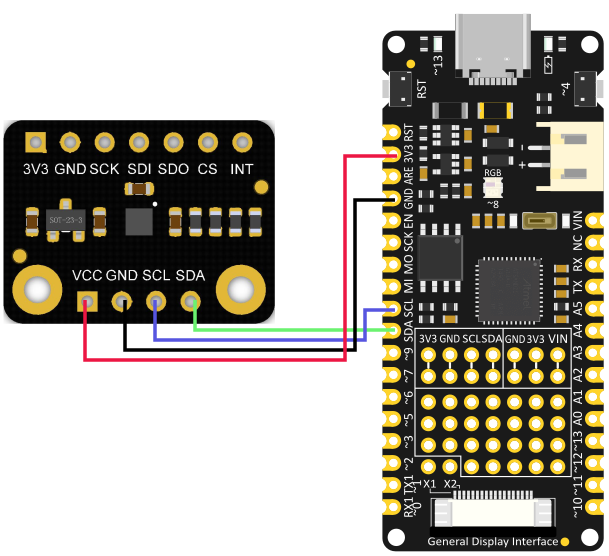
Sample Code
-
Select set_ODR_OSR_IIR.ino

-
Burning program
/*!
 * @file set_ODR_OSR_IIR.ino
 * @brief Advanced data processing settings, configure more advanced data sampling and processing modes that meet your needs more.
 * @n Configure measurement mode: sleep mode, enforcement mode, normal mode
 * @n Configure pressure and temperature over-sampling mode (increase sampling times)
 * @n Set the output data rate setting in subdivision/sub-sampling mode (set the data output rate, which must be less than the sampling frequency)
 * @n IIR filter coefficient setting (filter noise)
 * @copyright   Copyright (c) 2010 DFRobot Co.Ltd (http://www.dfrobot.com)
 * @licence     The MIT License (MIT)
 * @author [qsj](qsj.huang@dfrobot.com)
 * @version  V0.1
 * @date  2021-4-30
 * @get from https://www.dfrobot.com
 * @url https://github.com/DFRobot/DFRobot_BMP3XX
 */
#include <DFRobot_BMP3XX.h>

/**
* Select the chip version BMP388/BMP390L
* Select communication interface IIC, please comment out SPI interface.
* IIC communication address settings: eSDOGND: connect SDO pin to GND, I2C address is 0×76 now.
*                   eSDOVDD: Connect SDO pin to VDDIO (3v3), I2C address is 0×77 now
* Notice: If using Gravity products, IIC communication address is 0×77 by default
*/
//DFRobot_BMP388_IIC sensor(&Wire, sensor.eSDOVDD);
 DFRobot_BMP390L_IIC sensor(&Wire, sensor.eSDOVDD);

/**
* Select the chip version BMP388/BMP390L
* Select communication interface SPI, please comment out IIC interface.
* Set up digital pin according to the on-board pin connected with SPI chip-select pin.
* Notice: csPin used here is D3 digital pin on ESP32, other non-conflicting pins can also be selected as external interrupt pins
*/
// uint8_t csPin = D3;
// DFRobot_BMP388_SPI sensor(&SPI, csPin);
// DFRobot_BMP390L_SPI sensor(&SPI, csPin);


/* If you do not need to eliminate the absolute difference of measurement, please comment the following line */
#define CALIBRATE_ABSOLUTE_DIFFERENCE

void setup(void)
{
  Serial.begin(115200);

  int rslt;
  while( ERR_OK != (rslt = sensor.begin()) ){
    if(ERR_DATA_BUS == rslt){
      Serial.println("Data bus error!!!");
    }else if(ERR_IC_VERSION == rslt){
      Serial.println("Chip versions do not match!!!");
    }
    delay(3000);
  }
  Serial.println("Begin ok!");

  /**
  * Configure measurement mode and power mode
  * mode The measurement mode and power mode that need to set. The following modes add up to mode:
  *      ePressDIS: Disable pressure measurement, ePressEN: Enable pressure measurement
  *      eTempDIS: Disable temperature measurement, eTempEN: Enable temperature measurement
  *      eSleepMode, eForcedMode/, eNormalMode Three modes:
  *        Sleep mode: It will be in sleep mode by default after power-on reset. In this mode, no measurement is performed and power consumption is minimal. All registers
  *                    are accessible for reading the chip ID and compensation coefficient.
  *        Enforcement mode: In enforcement mode, the sensor will take a single measurement according to the selected measurement and filtering options. After the measurement
  *                     is completed, the sensor will return to sleep mode, and the measurement result can be obtained in the register.
  *        Normal mode: Continuously loop between the measurement period and the standby period. The measurement rate can be set in the odrSel register, and you can choose
  *                     the prescaler with different sampling frequency Fsampling=200Hz.
  */
  sensor.setPWRMode(sensor.ePressEN +
                    sensor.eTempEN +
                    sensor.eNormalMode);

  /**
  *  Configure the oversampling when measuring pressure and temperature
  *  mode Oversampling mode of pressure and temperature measurement need to set. The following modes add up to mode:
  *       6 pressure oversampling mode:
  *         ePressOSRMode1, Pressure sampling × 1, 16 bit / 2.64 Pa (Recommend temperature oversampling × 1)
  *         ePressOSRMode2, Pressure sampling × 2, 16 bit / 2.64 Pa (Recommend temperature oversampling × 1)
  *         ePressOSRMode4, Pressure sampling × 4, 18 bit / 0.66 Pa (Recommend temperature oversampling × 1)
  *         ePressOSRMode8, Pressure sampling × 8, 19 bit / 0.33 Pa (Recommend temperature oversampling × 2)
  *         ePressOSRMode16, Pressure sampling × 16, 20 bit / 0.17 Pa (Recommend temperature oversampling × 2)
  *         ePressOSRMode32, Pressure sampling × 32, 21 bit / 0.085 Pa (Recommend temperature oversampling × 2)
  *       6 temperature oversampling mode
  *         eTempOSRMode1, Temperature sampling × 1, 16 bit / 0.0050 °C
  *         eTempOSRMode2,  Temperature sampling × 2, 16 bit / 0.0025 °C
  *         eTempOSRMode4,  Temperature sampling × 4, 18 bit / 0.0012 °C
  *         eTempOSRMode8,  Temperature sampling × 8, 19 bit / 0.0006 °C
  *         eTempOSRMode16,  Temperature sampling × 16, 20 bit / 0.0003 °C
  *         eTempOSRMode32,  Temperature sampling × 32, 21 bit / 0.00015 °C
  */
  sensor.setOSRMode(sensor.ePressOSRMode4 +
                    sensor.eTempOSRMode1);

  /**
  * Configure output data rate in subdivision/sub-sampling mode
  * mode The output data rate needs to set, configurable mode
  *      BMP3XX_ODR_200_HZ,BMP3XX_ODR_100_HZ,BMP3XX_ODR_50_HZ,BMP3XX_ODR_25_HZ,BMP3XX_ODR_12P5_HZ,
  *      BMP3XX_ODR_6P25_HZ,BMP3XX_ODR_3P1_HZ,BMP3XX_ODR_1P5_HZ,BMP3XX_ODR_0P78_HZ,BMP3XX_ODR_0P39_HZ,
  *      BMP3XX_ODR_0P2_HZ,BMP3XX_ODR_0P1_HZ,BMP3XX_ODR_0P05_HZ,BMP3XX_ODR_0P02_HZ,BMP3XX_ODR_0P01_HZ,
  *      BMP3XX_ODR_0P006_HZ,BMP3XX_ODR_0P003_HZ,BMP3XX_ODR_0P0015_HZ
  */
  while( !sensor.setODRMode(BMP3XX_ODR_50_HZ) ){
    Serial.println("Set ODR mode fail! Please select lower frequency!");
    delay(3000);
  }

  /**
  * IIR filter coefficient configuration
  * mode Set IIR filter coefficient, configurable mode:
  *      BMP3XX_IIR_CONFIG_COEF_0,BMP3XX_IIR_CONFIG_COEF_1,BMP3XX_IIR_CONFIG_COEF_3,
  *      BMP3XX_IIR_CONFIG_COEF_7,BMP3XX_IIR_CONFIG_COEF_15,BMP3XX_IIR_CONFIG_COEF_31,
  *      BMP3XX_IIR_CONFIG_COEF_63,BMP3XX_IIR_CONFIG_COEF_127
  */
  sensor.setIIRMode(BMP3XX_IIR_CONFIG_COEF_3);

  delay(100);
  #ifdef CALIBRATE_ABSOLUTE_DIFFERENCE
  /**
  * Calibrate the sensor according to the current altitude
  * In this example, we use an altitude of 540 meters in Wenjiang District of Chengdu (China). Please change to the local altitude when using it.
  * If this interface is not called, the measurement data will not eliminate the absolute difference
  * Note: This interface is only valid for the first call
  */
  if( sensor.calibratedAbsoluteDifference(540.0) ){
    Serial.println("Absolute difference base value set successfully!");
  }
  #endif
}

void loop()
{
  /* Read currently measured temperature date directly, unit: °C */
  float temperature = sensor.readTempC();
  Serial.print("temperature : ");
  Serial.print(temperature);
  Serial.println(" C");

  /* Directly read the currently measured pressure data, unit: pa */
  float Pressure = sensor.readPressPa();
  Serial.print("Pressure : ");
  Serial.print(Pressure);
  Serial.println(" Pa");

  Serial.println();
  delay(1000);
}
Result

Additional Information
**Notice: **The tutorial example uses an altitude of 540 meters in Wenjiang District, Chengdu (China). Please change to the local altitude calibration when actually using it.
Was this article helpful?