Gravity: GNSS-RTK High Precision Positioning Kit-US

SKU: KIT0198-US

DFRobot¡¯s entry-level RTK positioning kit offers centimeter-level accuracy within 1.5KM in open areas. It uses Quectel¡¯s LC29HDA rover and LC29HBS base modules, plus LoRa wireless transmission. Both are L1/L5 dual-frequency, supporting GPS, GLONASS, Galileo, BDS, QZSS. The kit has a pre-configured data link (no user setup), ideal for RTK learning, device tracking, trajectory mapping, and personnel positioning.

Overview of GNSS-RTK High Precision Positioning Kit

Downloadable Resources

  • Docs
  • Tech Specs
  • 1. Getting StartedNew

    Starting with the basics of GPS/GNSS and the principles of RTK centimeter-level positioning, this book gradually analyzes the RTK data link and the NMEA 0183 GGA statement fields.

    2. Example Code for Arduino-Reading Data via UARTNew

    Read latitude, longitude, and positioning status from the GNSS-RTK kit using the UART protocol with Arduino IDE.

    3. Example Code for Arduino-Reading NMEA Data via I2C Protocol

    Read NMEA data from the GNSS-RTK kit using the I2C protocol with Arduino IDE.

    4. Example Code for Raspberry Pi-UART Tutorial

    Read GNSS data from the GNSS-RTK kit using the UART protocol with Raspberry Pi.

    5. Example Code for Raspberry Pi-I2C TutorialNew

    Read GNSS data from the GNSS-RTK kit using the I2C protocol with Raspberry Pi.

    Reference

    文档提供GNSS Arduino API Reference,涵盖getUTC、getDate、getLat、getLon、getAlt、getNumSatUsed等定位接口及setModule、setModuleBaud、setCallback等模块控制函数,并附GNSS Protocol Specification

    1. Specification

    1.1 Base Station

    Parameter Details
    Power Supply Type-C
    Terminal: 5~10V
    GNSS Antenna Interface SMA
    Reception Bands GPS/QZSS: L1 C/A, L5
    GLONASS: L1
    Galileo: E1, E5a
    BDS: B1I, B2a
    Default Constellations GPS + GLONASS + Galileo + BDS + QZSS
    Concurrent Constellations 4 + QGNSS
    Function Base station
    Sensitivity Acquisition: -147 dBm
    Tracking: -165 dBm
    Reacquisition: -159 dBm
    Dynamic Performance Max Altitude: 10000 m
    Max Velocity: 500 m/s
    Max Acceleration: 4g
    Raw Data Update Rate 1 Hz
    Protocol NMEA 0183 / RTCM 3.x

    1.2 Mobile Station (RTK Mobile)

    Parameter Details
    Operating Voltage 3.3V~5V
    Output Signal I2C/UART
    Antenna Interface SMA
    Reception Bands GPS/QZSS: L1 C/A, L5
    GLONASS: L1
    Galileo: E1, E5a
    BDS: B1I, B2a
    Default Constellations GPS + GLONASS + Galileo + BDS + QZSS
    Concurrent Constellations 4 + QGNSS
    SBAS WAAS, EGNOS, MSAS, GAGAN
    Function RTK
    Horizontal Positioning Accuracy Autonomous: 1 m
    RTK: 5 cm + 1 ppm
    Velocity Accuracy 0.03 m/s
    1PPS Accuracy 20 ns
    RTK Convergence Time <10 s
    Sensitivity Acquisition: -145 dBm
    Tracking: -165 dBm
    Reacquisition: -157 dBm
    Dynamic Performance Max Altitude: 10000 m
    Max Velocity: 500 m/s
    Max Acceleration: 4g
    Navigation Update Rate(RTK) 1 Hz
    Raw Data Update Rate(GNSS) 1 Hz
    Protocol NMEA 0183 / RTCM 3.x
    LoRa Parameters RF Chip Semtech: LLCC68
    Operating Frequency: 915MHz
    Modulation: LoRa Spread Spectrum
    Max Transmit Power: 22dBm
    Receiver Sensitivity: -129dBm
    Weight 700g

    2. Appearance and Interface

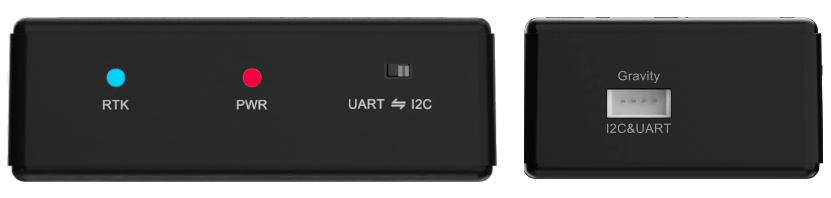
    2.1 Mobile Station

    Mobile

    Name Description
    RTK RTK status LED: Blinks at 1Hz for state 5 (positioning); Steady for state 4; Off for other states.
    PWR Power indicator
    UART I2C Toggle switch for UART/I2C communication interface
    Gravity I2C&UART Gravity interface for data output

    2.2 Base Station

    Base Station

    Name Description
    Type-C Type-C power interface
    PWR Power indicator
    PWR IN External terminal power (5~10V)

    3. Product Features

    • LoRa Data Transmission: Utilizes LoRa wireless technology for stable, long-range, and low-power communication of RTCM correction data between the base station and rover(s).

    • User-Friendly: Designed for ease of use with a pre-configured data link, enabling rapid setup and operation right out of the box.

    • Low Cost of Use: Provides an accessible entry point into high-precision positioning technology, minimizing initial investment and complexity.

    • Centimeter-Level Accuracy in Open Areas: Achieves high-precision centimeter-level positioning under optimal open-sky conditions.

    • Single Base Station Supports Multiple Mobile: One base station can broadcast correction data to several Mobile units simultaneously, improving efficiency and scalability.

    Was this article helpful?

    TOP