RS485 Soil pH, Moisture, Temperature Monitoring Sensor

SKU: SEN0602

This Soil Temperature, Humidity & pH Sensor measures soil temperature, humidity, and pH. It has a 5-30V wide voltage supply, RS485 output, fast response, and stable output. Compatible with Arduino UNO R3 + TTL-485 board for quick setup. IP68 protection, vacuum-sealed with black flame-retardant epoxy. 316 stainless steel probe (rust-proof, waterproof, anti-corrosion, salt-alkali & long-term electrolysis resistant). Small, suitable for long-term soil burial and various soil types.

Overview of RS485 Soil emperature&Humidity&pH Sensor

Downloadable Resources

  • Docs
  • Tech Specs
  • Specification

    Parameter Details
    Power supply voltage DC5-30V
    Power consumption 0.5W@24V
    Output mode RS485
    Detection parameters temperature、humidity、ph
    Humidity parameters - Measuring range: 0-100%
    - Resolution: 0.1%
    - Accuracy: 0-50%@±2%, 50-100%@±3%
    Temperature parameters - Measuring range: -40°C~+80°C
    - Resolution: 0.1°C
    - Accuracy: ±0.5°C
    PH parameters - Measuring range: 3-9PH
    - Resolution: 0.1PH
    Protection level IP68
    Probe material anti-corrosion special electrode
    Sealing material black flame retardant epoxy resin
    Working temperature -20°C~+60°C
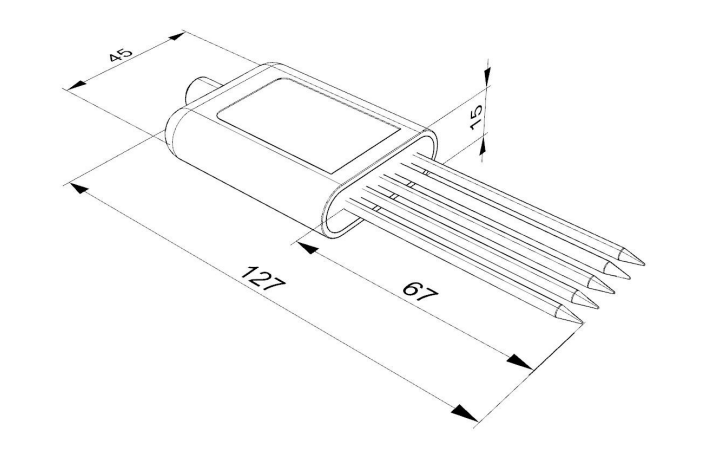
    Size 127x45x15mm
    Cable length 2m

    Pinout

    Num Label Description
    Brown line VCC Power input positive pole, DC5-30V power supply
    Black line GND Power ground wire
    Yellow line 485-A RS485 data line A
    Blue line 485-B RS485 data line B
    Dimensional Drawing

    FAQ

    • Hello
      with reference to the:
      MODBUS-RTU RS485 Soil Temperature, Humidity and pH Monitoring Sensor (IP68, 5-30V).. limitations? could i use arduino with short burst pH measurements to reduce power consumption.

      what is the accuracy of th pH measurement (low EC).
      also the humidity is volumetric and if so what is the volume/area of measurement around sensor.

    • Possible reasons for no output or output errors

      1. The computer has a COM port, but the selected port is incorrect.

      2. TTL to 485 module operation/programming toggle switch selection is incorrect.

      3. Wrong baud rate.

      4. The 485 bus is disconnected, or the A and B lines are connected reversely.

      5. If there are too many devices or the wiring is too long, power supply should be provided nearby.

      Equipment damage.

    Explore More Related Questions >

    Was this article helpful?

    TOP